
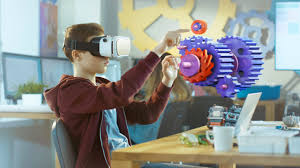
Virtual reality (VR) is transforming education by creating immersive, interactive learning experiences that go beyond traditional classroom methods. Unlike conventional teaching tools, VR enables students to engage with content in three-dimensional, simulated environments, making abstract concepts tangible and complex ideas easier to understand. By combining sensory immersion with experiential learning, VR enhances engagement, retention, and critical thinking, offering students the opportunity to explore subjects in ways that were previously impossible.
One of the most significant benefits of VR in education is its ability to make learning experiential. Students can interact with realistic simulations of environments, objects, and scenarios, applying knowledge in hands-on ways. For example, biology students can explore the human body in three dimensions, chemistry learners can conduct virtual experiments, and history students can walk through reconstructed ancient civilizations. This active engagement encourages curiosity, experimentation, and problem-solving while reinforcing understanding through experience rather than memorization.
VR also supports personalized learning by adapting experiences to individual needs and learning styles. Immersive environments can be designed with varying difficulty levels, adjustable pacing, and interactive feedback. Students who require more time can revisit concepts, while those ready for advanced challenges can explore additional scenarios. Adaptive VR applications provide guidance based on student performance, offering hints, prompts, and assessments tailored to each learner, ensuring that education is accessible and effective for diverse abilities.
Collaboration is another key aspect enhanced by VR. Virtual classrooms allow students to work together in shared simulated spaces, regardless of physical location. Group projects, problem-solving exercises, and interactive discussions can be conducted in a fully immersive environment, promoting teamwork, communication, and social learning. Platforms like Engage VR and AltspaceVR enable learners to connect, collaborate, and interact with peers in meaningful ways, bridging geographical barriers while fostering community and engagement.
VR also supports experiential learning in professional and technical fields. Medical students can practice surgeries in realistic simulations without risk, engineering students can manipulate virtual machinery to understand mechanics, and environmental science learners can model ecosystems to study ecological impacts. By allowing experimentation in a safe, controlled environment, VR reduces the consequences of mistakes, promotes deeper comprehension, and builds confidence in real-world applications.
Engagement and motivation are significantly enhanced through VR experiences. The immersive nature of VR captures attention, making learning more enjoyable and memorable. Students are more likely to remain focused and retain information when they are actively participating in interactive simulations rather than passively listening to lectures. Narrative-driven VR experiences can also make subjects more relatable and emotionally impactful, connecting learning to real-world contexts.
Despite its benefits, VR in education faces challenges. High-quality VR equipment and software can be expensive, potentially limiting access for schools or students with constrained resources. Ensuring usability, comfort, and safety is essential to prevent motion sickness, eye strain, or physical fatigue. Educators must also receive training to effectively integrate VR into curriculum, design meaningful activities, and facilitate learning in virtual environments. Addressing these challenges is critical to maximizing the potential of VR as a learning tool.
VR can also support inclusivity and accessibility. Students with physical or mobility limitations can engage in activities that might otherwise be difficult or impossible in the physical world. Simulations can be customized with adjustable controls, captions, and assistive features, ensuring that diverse learners can fully participate. VR experiences can also provide exposure to environments, scenarios, and cultures that may not be accessible in real life, broadening perspectives and understanding.
In addition to individual learning, VR provides powerful tools for assessment and analytics. Educators can track student interactions within virtual environments, monitoring decision-making, problem-solving approaches, and engagement levels. This data-driven insight helps teachers evaluate understanding, provide targeted feedback, and improve instructional design. AI integration within VR can further enhance personalization, dynamically adjusting experiences to meet learning objectives while maintaining engagement.
In conclusion, virtual reality is reshaping learning experiences by offering immersive, interactive, and personalized educational environments. By combining experiential learning, collaboration, and adaptive technology, VR enhances engagement, retention, and comprehension across a wide range of subjects. While challenges related to accessibility, cost, and training exist, thoughtful implementation ensures that VR can be a transformative tool in education. As technology advances, VR will continue to expand the boundaries of learning, creating opportunities for students to explore, experiment, and interact with knowledge in ways that are immersive, meaningful, and unforgettable.



Leave a Reply